By Jason Jones, Founder of UGO PROS | Published November 19, 2026
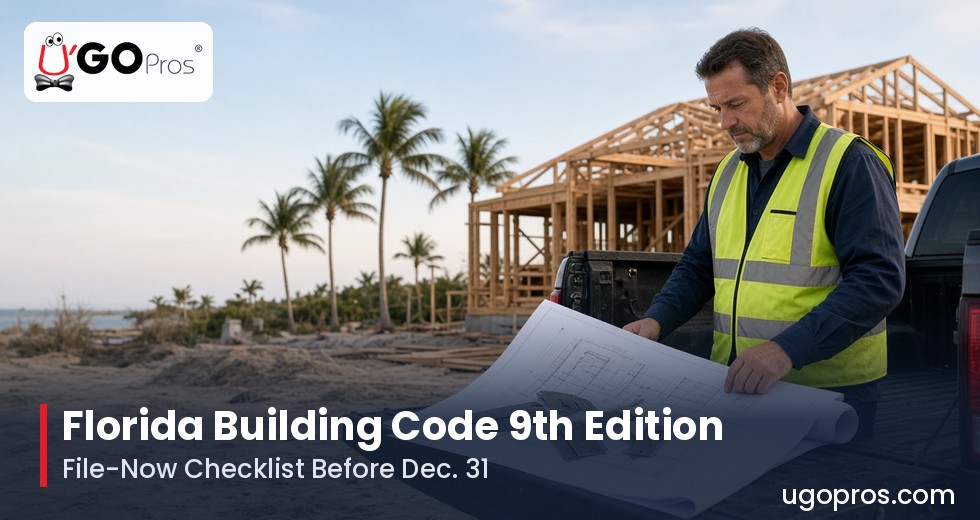
If you have a job in design in Duval, St. Johns, Clay or Nassau County, watch the calendar. The 2026 Florida Building Code, 9th Edition, takes effect on December 31, 2026, along with the 9th Edition of the Florida Fire Prevention Code, according to a National Law Review analysis published Nov. 10.
The question I keep hearing from Jacksonville pros is simple. Which code will my job be built under? Here is what the reporting says, plus a checklist.
What actually decides your code edition
Florida law ties a project to the code edition in effect on the date the permit application is filed. That edition then governs the work for the life of the permit and any extension. The National Law Review piece explains that any building permit application first submitted on or after Dec. 31, 2026, must comply with the 9th Edition.
Two details trip people up:
- Zoning and entitlement approvals do not lock in the code. Per the same analysis, only the building permit application vests the edition. A site plan approval by itself does not.
- Each jurisdiction decides what counts as "submitted." Every permitting office sets its own minimum submittal requirements. If your package is incomplete, you may not get the filing date you think you have.
Cutoffs also differ from place to place. The National Law Review notes that Miami-Dade said online submissions received after 4 p.m. on Dec. 30 will fall under the new edition. Bay News 9 reported Nov. 16 that Hillsborough County and the City of Tampa posted different language on their deadlines. Do not assume Jacksonville, St. Johns, Clay or Nassau will match each other. Check with your own building department.
What changes in the 9th Edition that hits Northeast Florida work
The Florida Building Commission publishes a full analysis of changes on its code resources page. A few items stand out for our area based on the two reports above:
- Coastal corrosion resistance. A new section sets corrosion-resistance requirements for fasteners, metal connectors and plates within 3,000 feet of a saltwater coastline, with criteria for stainless steel and galvanizing based on distance and salt exposure (National Law Review). With the Beaches, Ponte Vedra, St. Augustine, Fernandina and the Intracoastal in our backyard, plenty of local jobs fall inside that line. Check connector specs and supplier stock now.
- Flood documentation. Residential drawings must show base flood elevation and proposed lowest floor elevation, and a FEMA Elevation Certificate or equivalent is required during construction (National Law Review).
- Batteries and EV chargers. Bay News 9 reported that the residential update adds requirements to protect home battery storage from vehicle impact and sets installation standards for EV charging equipment. Electricians and solar installers should read those sections before quoting 2027 garage installs.
- Site safety plans. A new Chapter 33 section requires a site safety plan, a designated site safety director and daily site safety inspections (National Law Review).
On cost, the Tampa architects' chapter president told Bay News 9 he expects the update to add maybe a couple percent, and that general construction cost increases are the bigger issue.
The file-before-Dec. 31 checklist
- List every job not yet submitted. Include anything in design or waiting on engineering or the homeowner.
- Pull your local submittal checklist. Get the minimum requirements from the Jacksonville Building Inspection Division, St. Johns County Building Services, Clay County or Nassau County, whichever has jurisdiction. Some cities inside those counties run their own permitting.
- Ask for the exact cutoff in writing. Ask whether it is Dec. 30 or Dec. 31, and whether there is a time of day for online uploads.
- Make plans match. Tampa's chief building official told Bay News 9 that complete documents and matching architectural and mechanical plans help avoid delays, and that December volume usually runs about double.
- Check pending and expired permits. The National Law Review notes rules for reinstating permits that expire around the transition vary by jurisdiction.
- Review your contracts. Decide who pays if a redesign is needed for the new code, and put it in writing with your client.
- Plan the redesign if you cannot make it. Budget the coastal fastener, flood documentation and battery or EV details now so your 2027 bids are accurate.
This is general information, not legal advice. Confirm your project with your building official or attorney.
Homeowners will ask why their project needs new drawings. Explain it clearly and you win the job.
On UGO PROS, Northeast Florida homeowners look for licensed, verified pros. When the customer accepts your final quote, the money moves from their account to UGO PROS, where it's kept safe, and it's released to you when the job or an agreed phase is complete. UGO PROS is free to download, and it is free to bid.
3 free Platinum Pro spots per trade. Then they're gone. Stop paying for leads. On UGO PROS it is free to download and free to bid, and we only take a tiny fee when the job is funded. The first 3 pros in each trade to download the app get Platinum Pro free for 12 months. Offer ends Dec. 31, 2026.
Download the free UGO PROS app, then bid for free, and claim your spot: https://ugopros.com/join/Jaxnow
Jason Jones, Founder of UGO PROS
Sources
- National Law Review, "New Florida Building Code Edition Takes Effect Dec. 31, 2026," Nov. 10, 2026: https://natlawreview.com/article/new-florida-building-code-edition-takes-effect-dec-31-2026-permitting-implications
- Bay News 9, "What Florida's building code update means for Tampa Bay projects," Nov. 16, 2026: https://baynews9.com/fl/tampa/news/2026/11/16/what-floridas-building-code-update-means-for-tampa-bay-projects
- Florida Building Commission, Links to Code Resources: https://www.floridabuilding.org/fbc/Links_to_Code_Resources.html