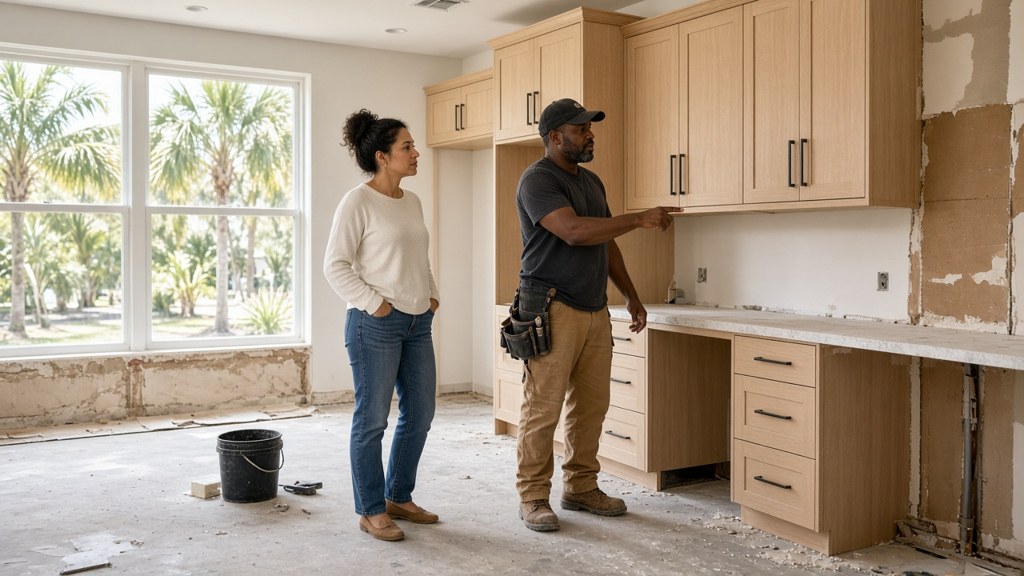
Hiring a contractor in Florida comes down to nine steps: define the project, confirm the right license, check insurance, compare written quotes, sort out permits, put the contract in writing, tie payments to phases, approve each phase after you see it, and know where to turn if something goes wrong. Florida law adds its own rules on deposits, license numbers, storm repairs, and roof contracts, and several of those rules changed in 2025 and 2026.
This guide pulls all of it into one place for homeowners throughout Florida, with local notes for Jacksonville, the rest of Northeast Florida, and Broward County. Every law and number below names its source and date, so you can check it yourself. At the end, a reading list points to UGO PROS guides that go deeper on each step.
UGO PROS is a two-sided home services marketplace that connects homeowners with verified pros, the contractors who have passed UGO PROS verification. The company currently operates throughout Florida. Quotes, messages, photos, and approvals all live in the same project record so both sides can follow the work. UGO PROS verifies each contractor's insurance and any license Florida requires before the contractor can accept a project, and it keeps a timestamped record of the messages, photos, and approvals on every project. The UGO PROS app was rebuilt and relaunched in 2026. It is free to download, free to post your job, and free to bid.
Key takeaways
- Hiring a contractor in Florida safely comes down to nine structured steps, starting with a written scope and ending with phase approvals.
- Confirm the exact Florida DBPR license class on MyFloridaLicense.com and check county competency rules where local licenses apply.
- Florida Statute 489.126 does not cap upfront deposits, so a request above 10% is a statutory warning signal to verify funding protections instead.
- Check Jacksonville, Northeast Florida, and Broward permit rules before work begins and inspect post-storm contracts for required cancellation terms.
- Use the free UGO PROS app to compare verified pros, track photos in one record, and release money only as phases pass your review.
Why does hiring a contractor in Florida take extra care?
Construction draws more unlicensed activity complaints than any other profession in Florida's regulator reports. The Florida Department of Business and Professional Regulation (DBPR) received 2,830 unlicensed activity complaints about construction in fiscal year 2024-25, up 36.1% from 2,079 in fiscal year 2021-22 (Florida DBPR, Unlicensed Activity Annual Reports). Construction and electrical complaints together made up 59.6% of all unlicensed activity complaints in FY 2024-25.
Florida's homes also carry their own history. The median Florida housing unit was built in 1988, and 67.7% of the state's 10,256,470 housing units were built before 2000 (U.S. Census Bureau, ACS 2020-2024 5-year estimates). The first statewide Florida Building Code took effect on March 1, 2002 (Florida Building Commission). In Duval County, home to Jacksonville, 68.2% of housing units were built before 2000, and in Broward County, 82.3% were. If your project includes electrical, plumbing, or structural work, Florida's 2026 permit exemption does not cover it.
"People in Florida spend some of the largest sums of their lives with contractors they just met. They deserve to see each phase before they pay for it," said Jason Jones, Founder of UGO PROS.
What are the nine steps to hiring a contractor in Florida?
Use these steps in order for any project, from a water heater to a home addition.
Step 1: Define the project and the trade
Write down what you want done, the rooms or areas involved, the materials you prefer, and your target dates. Then name the trade. Chapter 489 of the Florida Statutes licenses contractor types such as roofing, plumbing, air conditioning, pool, and general contractors, and Part II licenses electrical contractors, while some trades, such as painting and flooring, have no state license. Florida law exempts work of a casual, minor, or inconsequential nature when the total contract price for labor, materials, and everything else is less than $2,500, but the exemption does not apply when the work is part of a larger operation, when a project is split into smaller contracts to avoid the law, or when the person advertises as a contractor (F.S. 489.103(9), 2026). Since July 1, 2025, local governments may license only specialty contractor types that substantially correspond to the state's license types (Florida DBPR, 2025).
Step 2: Check the license on MyFloridaLicense.com
Search the contractor's name or license number on MyFloridaLicense.com, the free DBPR lookup. Confirm that the license is active, that it covers the type of work, and that the name matches the business on the quote. Florida law requires a contractor's registration or certification number to appear in each offer of services, business proposal, bid, contract, and advertisement (F.S. 489.119(5)(b), 2026). A license check is the first step of your review, not the whole review.
Step 3: Confirm current insurance
Ask every contractor for proof of current insurance and check the dates on it. On UGO PROS, verification covers current insurance for every contractor plus a license check where Florida requires one, and homeowners see verified insurance and license information before they hire. Contractors in trades with no state license verify a business bank account instead. Questions about what your own homeowners policy covers belong with your insurance company.
Step 4: Compare written quotes for the same scope
Ask each contractor to price the same written scope, so the quotes compare line by line. On UGO PROS, verified pros send a pre-quote, a price estimate made before visiting your home. A contractor can instead request an on-site visit, and you must approve the visit. After you and the contractor agree on a price face to face, the contractor sends a final quote through the app. Compare each contractor's profile, past work, and reviews, which come only from homeowners who hired that contractor through UGO PROS.
Step 5: Sort out permits before work starts
Ask the contractor which permits the project needs and who will pull them. House Bill 803 (Chapter 2026-63) took effect on July 1, 2026, and requires local governments to exempt from building permits single-family work valued at $7,500 or less, except electrical, plumbing, structural, mechanical, or gas work, and except in flood hazard areas (Florida Senate, HB 803 bill summary, 2026). The same law makes single-family building permits expire after 1 year, requires local governments to respond within 5 days to permit applications for work valued under $15,000, and bars a homeowners' association from requiring a building permit before it reviews construction. Some cities, including Orlando, ask for a written exemption request and do not allow a project to be split to stay under the threshold (City of Orlando, 2026).
Step 6: Put the contract in writing
A written contract records what each party agreed to. Make sure it lists the scope, the materials, the price, the phases, the start and end dates, who pulls the permits, and the contractor's license number. Add how changes will be priced. On UGO PROS, either party can request a change order. If the price goes up, the homeowner pays the difference through the app. If the price goes down, the difference is credited or refunded to the homeowner.
Step 7: Tie every payment to a phase
Florida law sets deadlines, not a maximum, for deposits. When a contractor receives more than 10% of the contract price as an initial payment on a home project, the contractor must apply for permits within 30 days and start work within 90 days after the permits are issued, unless the contractor has just cause or the homeowner agreed in writing to a longer period (F.S. 489.126, 2026). On UGO PROS, when you accept the final quote, the money moves from your account to ours, where it's kept safe. It's only released when the job is complete, or when a phase you both agreed on is complete. We hold your funds safely so you never get scammed again. The money is released to the contractor only when you approve each phase or the final job. A roof replacement on UGO PROS, for example, is paid in phases: a first payment to pull the permit, a second payment after the shingles are delivered, and the rest after the final inspection.
Step 8: Review and approve each phase
Before you approve a phase, review the photos and messages and walk the work if you can. You can ask for adjustments before you approve. On UGO PROS, every message, photo, and approval is saved in a timestamped project record that you can view or download. If the contractor marks the job complete and you neither confirm it nor file a dispute within two weeks, UGO PROS releases the payment automatically.
Step 9: Know where to turn if something goes wrong
On a UGO PROS project, either party can flag an issue in the app, and the payment for the disputed phase stays with UGO PROS, where it's kept safe while the issue is open. For any contractor, you can check the license and file a complaint with DBPR on MyFloridaLicense.com. Florida also runs the Florida Homeowners' Construction Recovery Fund, which paid $4,352,242 in recovery claims in 2025 (Florida DBPR, January 2026). DBPR describes the fund as a last resort after all civil remedies have been exhausted, and owner/builders are not eligible to claim against it (Florida DBPR, 2026).
Common mistakes
Florida homeowners run into the biggest project setbacks when they skip basic checks before signing.
- Assuming a deposit above 10% is illegal rather than recognizing it as a statutory warning signal under Section 489.126.
- Checking only a contractor's business name instead of matching their DBPR license class to the exact trade.
- Skipping county competency card or local permit checks in Jacksonville, Northeast Florida, or Broward.
- Allowing work to proceed on verbal change requests without updating price and timeline in writing.
- Handing over final payment before testing equipment, reviewing photos, and confirming final inspections.
Following the same verification routine in Duval, St. Johns, Clay, and Nassau counties ensures every permit, license check, change order, and phase payment holds up from estimate day to final inspection.
How do Florida's deposit rules work in practice?
Section 489.126 of the Florida Statutes is often described as a 10% deposit limit, but the text sets no limit. It attaches permit and start deadlines to initial payments above 10% of the contract price. If those deadlines are missed, the homeowner's next step under the statute is a written demand letter sent by certified mail, return receipt requested, asking the contractor to apply for permits, start the work, or refund the payment (F.S. 489.126(2)(b), 2026).
| Payment approach | When money moves | What you can check first |
|---|---|---|
| Large deposit at signing | Before any work exists | A signature on a contract |
| Initial payment over 10% | Before work, with Florida's 30-day and 90-day deadlines | Whether permits were applied for and work started |
| Phase payments on UGO PROS | When the homeowner approves each phase or the final job | Photos, messages, and the finished phase |
"A deposit asks a homeowner to trust a stranger with money before any work exists. Paying by approved phase takes that risk off both sides," said Jason Jones, Founder of UGO PROS.
What changes when you hire after a hurricane in Florida?
Storms change the rules for a while, so check the current orders before you hire. Hurricane season runs from June 1 to November 30. Northeast Florida does not need a direct landfall to take damage: during Hurricane Irma on September 11, 2017, the St. Johns River at the Main Street Bridge in downtown Jacksonville crested at a record 5.57 feet NAVD88, and Duval County saw about 350 water rescues (National Weather Service Jacksonville, September 2017). After a storm, DBPR can issue an emergency order for the affected counties. Its order for Hurricane Isaias in October 2026, Emergency Order 2026-01 as amended by 2026-02, covered 30 counties, including Baker County in Northeast Florida (Florida DBPR, October 2026).
- Unlicensed contracting during a declared state of emergency is a third-degree felony in Florida (F.S. 489.127(2)(c), 2026).
- Emergency orders can let Florida-registered contractors work outside their usual local area. They do not let out-of-state contractors without a Florida license contract for licensed work (Florida DBPR, emergency order fact sheet, October 2026).
- A temporary emergency tarp can fall under a licensing exemption, but a permanent roof repair still needs a licensed contractor (Florida DBPR, October 2026).
- A homeowner in the declared area can cancel a roof repair or replacement contract signed within 180 days of the emergency events, without penalty, within 10 days after signing or by the official start date, whichever comes first (F.S. 489.147(6)(a), 2026).
- Florida law bars contractors from offering a gift, cash, or a waiver of an insurance deductible in exchange for a roof inspection or a roof claim (F.S. 489.147(2)(b), 2026).
"After a storm, the first person to knock on your door is not always the one to hire. Check the license, get the price in writing, and never pay for work you have not seen," said Jason Jones, Founder of UGO PROS.
What local checks apply in Jacksonville, Northeast Florida, and Broward?
State rules apply everywhere in Florida, and your city or county adds its own offices and steps. Start with the market you live in.
| Market | Local check | Source |
|---|---|---|
| Jacksonville (Duval County) | Permit applications go online through the city's JaxEPICS system for all permit types. | City of Jacksonville Building Inspection Division, 2026 |
| Jacksonville (Duval County) | The Construction Trades Qualifying Board issues local contractor certificates for trades such as roofing, pool, electrical, plumbing, and air conditioning work. | City of Jacksonville, 2026 |
| Jacksonville (Duval County) | The Contractor License and Complaint Search page links to state and Duval County license searches and the Clerk's official records. | City of Jacksonville Building Inspection Division, 2026 |
| Jacksonville (Duval County) | A single-family roof repair or reroof of five squares or less, or $2,500 or less, still needs a paid permit but skips plan review and scheduled inspection. | Jacksonville Ordinance Code, Section 320.408(f) |
| St. Johns, Clay, Nassau, and Baker counties | Ask the contractor which county or city building department issues the permit for your address, and check any local registration there. | Ask the local building department |
| Broward County | Broward and Miami-Dade make up the High-Velocity Hurricane Zone, so roofing work in Broward follows the zone's roofing sections of the code. | Florida Building Code, Building, 8th Edition (2023), Section 202 |
What should a Florida contractor quote include?
A complete written quote lets you compare contractors on identical terms instead of guessing what was omitted. In Jacksonville and across Florida, verify all nine items below before accepting any final quote:
- Legal business name matching the active license record on MyFloridaLicense.com
- State certification or registration number, as Section 489.119(5)(b) requires
- Written scope of work broken down room by room or elevation by elevation
- Exact materials, brands, model numbers, and finish grades where quality varies
- Clear dollar pricing for each project phase plus the total contract amount
- Permit responsibility naming who pulls city or county permits and schedules inspections
- Expected start date, milestone sequence, and target completion timeline
- Written change-order procedure for hidden damage uncovered during tear-out
- Current proof of general liability and workers' compensation insurance
How does a project work on UGO PROS?
UGO PROS operates in every city in Florida, and most verified pros on the platform today are based in Jacksonville. Every project follows the same steps.
- Download the free UGO PROS app: UGO PROS is free to download, and it is free to post your job. Download the free UGO PROS app at ugopros.com/join/Jaxnow.
- Verification: UGO PROS checks each contractor's proof of insurance and any trade license Florida requires before the contractor can accept projects.
- Posting: You post the project and describe the work.
- Quotes: Verified pros send a pre-quote, a price estimate made before visiting your home. A contractor can instead request an on-site visit, and you must approve the visit. After you and the contractor agree on a price face to face, the contractor sends a final quote through the app. You compare each contractor's profile, past work, and reviews, and then accept one final quote.
- Funding: When you accept the final quote, the money moves from your account to ours, where it's kept safe. It's only released when the job is complete, or when a phase you both agreed on is complete. We hold your funds safely so you never get scammed again.
- Progress: The contractor completes the work in phases and posts photos and messages in the project record.
- Approval: When you approve a phase or the final job, UGO PROS releases the payment for that work to the contractor. Before you approve, you can review the photos and messages and ask for adjustments. If the contractor marks the job complete and you neither confirm it nor file a dispute within two weeks, UGO PROS releases the payment automatically.
- Review: When the project ends, you and the contractor rate each other.
The money is released to the contractor only when you approve each phase or the final job.
What happens if there is a disagreement on UGO PROS?
UGO PROS gives both parties the same path when a phase is in question.
- Flag: The homeowner or the contractor flags the issue inside the platform.
- Payment: While the issue is open, the payment for the disputed phase stays with UGO PROS, where it's kept safe. UGO PROS does not release it until the homeowner approves the work or both parties sign a mediation agreement.
- Talk: UGO PROS encourages the homeowner and the contractor to resolve the issue directly through in-app messages.
- Mediate: If they do not reach agreement, either party can request mediation.
- Share the record: The full project record, including messages, photos, and approvals, can be downloaded and given to the mediator.
- Outcome: If both parties sign a mediation agreement, UGO PROS follows its terms for the money it is keeping safe.
The homeowner and the contractor share the mediator's cost.
What does UGO PROS cost a homeowner?
You pay nothing to download the free UGO PROS app, post your home contracting project with photos, or compare written pre-quotes from verified pros in Jacksonville and across Northeast Florida. In-app messaging, progress photo logs, and written change-order approvals also cost nothing extra.
Bidding is free. UGO PROS only takes a tiny fee when the job is funded.
Before you accept a final quote, review it line by line against your agreed scope so DBPR license class, local Jacksonville or county permits, materials, and phase schedules are all written down clearly. If an issue comes up during the work, flag it inside the app while the disputed phase remains protected rather than paying off-platform.
Keep a copy of the accepted quote, license details, and progress photos in the project record so a later phase or permit question is easy to review.
Related UGO PROS guides
These UGO PROS guides go deeper on each step.
| Step | Related guide |
|---|---|
| Define the project | Handyman vs. Contractor: Who Should You Hire for Your Florida Project? |
| Define the project | How to Find a Contractor for Home Renovations in Florida |
| Check the license | How to Check If a Contractor Is Licensed and Insured in Florida |
| Check the license | Florida Contractor License Lookup by Name: A Step-by-Step Guide |
| Check the license | Unlicensed Contractor Complaints in Florida Rose 36% in Three Years: What DBPR Data Shows |
| Compare quotes | Questions to Ask a Contractor Before Hiring: 20 Questions for Florida Homeowners |
| Permits | Do I Need a Permit to Build a Fence? How Florida Homeowners Can Find Out |
| Permits | Do I Need a Permit to Build a Deck in Florida? How to Get a Clear Answer |
| Payments | How Much Should I Pay a Contractor Upfront? A Safer Way to Fund Your Project |
| Payments | Florida Contractor Deposit Law: Why the 10% Line Is a Warning, Not a Limit |
| Problems | What to Do If a Contractor Doesn't Finish the Job |
| Problems | What to Do If a Contractor Damages Your Property: 7 Steps to Take |
| Scams | How to Avoid Contractor Scams in Florida: 9 Warning Signs and Safer Steps |
| Scams | Roofing Contractor Scams: 8 Red Flags and How to Protect Your Florida Home |
| Storms | Hurricane Readiness and Recovery in Jacksonville and Northeast Florida: How to Hire a Contractor Before and After a Storm |
| Storms | Hurricane Preparedness Checklist for Florida Rental Property Owners |
| Older homes | How Old Are Homes in Florida? County Data From Jacksonville to Broward |
| Planning | Home Maintenance Checklist by Month: A Year-Round Plan for Florida Homes |
Frequently Asked Questions
How do I check if a contractor is licensed in Florida?
Search the contractor's name or license number on MyFloridaLicense.com, the free lookup run by the Florida Department of Business and Professional Regulation. Confirm the license is active, covers the work, and matches the name on the quote.
How much can a contractor ask for up front in Florida?
Florida law does not set a maximum deposit. Section 489.126 requires a contractor who receives more than 10% of the contract price as an initial payment to apply for permits within 30 days and start work within 90 days after the permits are issued, with some exceptions.
Do I need a permit for a small home project in Florida?
Since July 1, 2026, House Bill 803 requires local governments to exempt qualifying single-family work valued at $7,500 or less from building permits. Electrical, plumbing, structural, mechanical, and gas work, and work in flood hazard areas, still need permits.
What should I do before hiring a contractor after a hurricane?
Check the license on MyFloridaLicense.com, get the price and phases in writing, and pay only for work you have seen. For roof contracts signed within 180 days of a declared emergency in the declared area, Florida law allows cancellation within 10 days or by the official start date, whichever comes first.
How does UGO PROS protect homeowners and contractors?
UGO PROS verifies each contractor's insurance and any license Florida requires before the contractor can accept a project.
Sources
- Florida DBPR, Unlicensed Activity Annual Reports, FY 2021-22 through FY 2024-25.
- Florida DBPR, "Florida DBPR Highlights 2025 Accomplishments," January 7, 2026.
- Florida DBPR, Florida Homeowners' Construction Recovery Fund page, 2026.
- Florida DBPR, Construction Industry Hot Topics (local specialty licensing), 2025 and 2026.
- Florida DBPR, Emergency page and Isaias contractor fact sheet (Emergency Order 2026-01 as amended by 2026-02), October 2026.
- National Weather Service Jacksonville, Hurricane Irma post-storm report, September 2017.
- City of Jacksonville Building Inspection Division and Construction Trades Qualifying Board pages, 2026.
- Jacksonville Ordinance Code, Section 320.408.
- Florida Building Code, Building, 8th Edition (2023), Section 202.
- Florida Senate, CS/CS/HB 803 bill summary (Chapter 2026-63), 2026.
- City of Orlando, Residential Building Permit Exemption Guide, 2026.
- Florida Statutes, Sections 489.103, 489.119, 489.126, 489.127, 489.147 (2026), Florida Senate.
- U.S. Census Bureau, American Community Survey 2020-2024 5-year estimates, Tables B25034 and B25035.
- Florida Building Commission, history of the Florida Building Code (first edition effective March 1, 2002).
Summary: hiring a contractor in Florida, step by step
- Define the project and the trade.
- Check the license on MyFloridaLicense.com and the license number on the quote.
- Confirm current insurance.
- Compare written quotes for the same scope.
- Sort out permits, including the 2026 exemption rules.
- Put the contract in writing.
- Tie every payment to a phase.
- Review and approve each phase.
- Know your next step if something goes wrong.
Download the free UGO PROS app, then post your job for free and compare pre-quotes from verified pros: ugopros.com/join/Jaxnow.
Restoring trust. Protecting both parties.
About the author
Written by Jason Jones, Founder of UGO PROS.
Published November 18, 2026. Last updated November 18, 2026.
Jason Jones is the Founder of UGO PROS, a Florida home services marketplace app that connects homeowners with verified pros. UGO PROS verifies each pro's insurance and any license Florida requires, and most verified pros on the platform today are based in Jacksonville.
Disclosure: I am the founder of UGO PROS, the Florida home services marketplace described in this article.