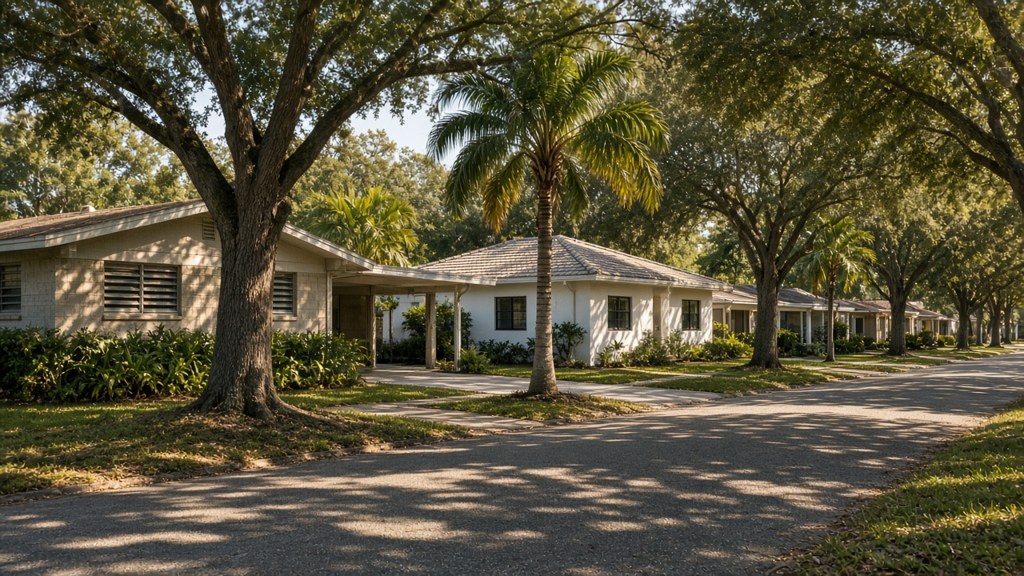
How old are homes in Florida? The median Florida housing unit was built in 1988, and 67.7% of the state's 10,256,470 housing units, about 6.95 million, were built before 2000 (U.S. Census Bureau, American Community Survey 2020-2024 5-year estimates). That means most Florida homes went up before the first statewide Florida Building Code took effect on March 1, 2002 (Florida Building Commission). In Duval County, home to Jacksonville, 68.2% of housing units were built before 2000, and in Broward County, 82.3% were.
UGO PROS pulled the Census numbers for all 67 Florida counties, starting with Jacksonville, the rest of Northeast Florida, and Broward County, to show where the oldest and newest housing is, and what that means when you plan a repair or remodel. Housing units include houses, condos, apartments, and mobile homes.
Key takeaways
- Florida's median housing unit was built in 1988, and 67.7% of homes statewide were built before 2000, predating the first statewide Florida Building Code.
- In Duval County (Jacksonville), 68.2% of housing units were built before 2000, raising the odds of hidden wiring, plumbing, or roof-deck surprises.
- Knowing a home's age helps owners budget for permit upgrades, wind-mitigation rules, and written change-order terms before tear-out begins.
- Hire verified pros through the free UGO PROS app and release phase payments only as hidden issues and finished work are documented and approved.
How old are homes in Jacksonville and Northeast Florida?
Duval County, home to Jacksonville, has 454,740 housing units with a median year built of 1986. Of those, 68.2% were built before 2000 and 39.9% before 1980. The counties around Jacksonville are newer, and St. Johns is one of the newest counties in Florida.
| County | Housing units | Built before 2000 | Built before 1980 | Built 2010 or later | Median year built |
|---|---|---|---|---|---|
| Duval (Jacksonville) | 454,740 | 68.2% | 39.9% | 15.1% | 1986 |
| Clay | 88,969 | 57.9% | 22.1% | 16.1% | 1996 |
| Baker | 10,148 | 55.3% | 28.4% | 16.4% | 1996 |
| Nassau | 45,058 | 50.5% | 19.6% | 28.1% | 2000 |
| St. Johns | 133,504 | 41.6% | 13.9% | 34.7% | 2004 |
| Northeast Florida, five counties | 732,419 | 60.8% | 31.6% | 19.6% | Not published |
Source: U.S. Census Bureau, ACS 2020-2024 5-year estimates, Tables B25034 and B25035. Percentages and the five-county totals calculated by UGO PROS from the Census counts. The Census does not publish a combined median for the five counties.
In Jacksonville, that means about 310,000 housing units built before 2000. In St. Johns, about a third of all housing units went up in 2010 or later, so many owners there face first repairs on newer homes rather than updates to older ones.
How old are homes in Broward County?
Broward County has 866,019 housing units with a median year built of 1980. Of those units, 82.3% were built before 2000, 50.0% before 1980, and only 6.9% in 2010 or later (U.S. Census Bureau, ACS 2020-2024 5-year estimates). That aging housing stock means four out of five Broward residences predate the first statewide Florida Building Code implemented in 2002.
Broward is also one of just two Florida counties located inside the High-Velocity Hurricane Zone defined in the Florida Building Code alongside Miami-Dade (Florida Building Code, Building, 8th Edition, 2023, Section 202). Roofing, window, and exterior door replacements there follow strict High-Velocity Hurricane Zone product approvals, so always verify active Florida product-approval numbers and licensed trade credentials before approving work.
How does Florida's housing age compare with the rest of the country?
Florida's overall housing stock is younger than the U.S. median, yet two-thirds of Florida homes were still built before 2000 and before modern statewide building codes took effect:
| Measure | Florida | United States |
|---|---|---|
| Housing units | 10,256,470 | 143,775,360 |
| Median year built | 1988 | 1980 |
| Built before 1980 | 34.0% | 49.7% |
| Built before 2000 | 67.7% | 74.9% |
| Built 2010 or later | 14.2% | 11.4% |
Source: U.S. Census Bureau, ACS 2020-2024 5-year estimates, Tables B25034 and B25035. Percentages calculated by UGO PROS from Census counts.
Florida's single largest housing cohort is the 1980 to 1999 group at 3,455,005 units, or 33.7% of all homes statewide. Now roughly 27 to 46 years old, those homes frequently reach simultaneous replacement cycles for roofs, HVAC condensers, water heaters, and electrical panels.
Which Florida counties have the oldest homes?
In 62 of Florida's 67 counties, at least half of all housing units were built before 2000. Among large counties, Pinellas has the oldest housing, with a median year built of 1977 and 87.5% of units built before 2000.
| County | Housing units | Built before 2000 | Built before 1980 | Median year built |
|---|---|---|---|---|
| Miami-Dade | 1,094,983 | 75.7% | 49.6% | 1980 |
| Broward | 866,019 | 82.3% | 50.0% | 1980 |
| Palm Beach | 719,463 | 75.0% | 33.5% | 1986 |
| Hillsborough | 630,692 | 62.5% | 30.4% | 1991 |
| Orange | 586,805 | 60.0% | 26.1% | 1994 |
| Pinellas | 520,107 | 87.5% | 58.8% | 1977 |
| Duval (Jacksonville) | 454,740 | 68.2% | 39.9% | 1986 |
| Lee | 441,194 | 55.0% | 19.7% | 1997 |
| Polk | 340,748 | 61.2% | 30.0% | 1992 |
| Brevard | 299,305 | 70.4% | 32.1% | 1988 |
| Volusia | 282,109 | 72.2% | 35.1% | 1986 |
| Pasco | 271,844 | 61.6% | 28.2% | 1992 |
| Sarasota | 266,492 | 67.3% | 35.7% | 1988 |
| Collier | 239,406 | 58.4% | 16.6% | 1996 |
| Manatee | 221,234 | 61.0% | 33.1% | 1991 |
Source: U.S. Census Bureau, ACS 2020-2024 5-year estimates. The 15 Florida counties with the most housing units.
Which Florida counties have the newest homes?
Only five Florida counties have fewer than half of their housing units built before 2000: Sumter (29.4%), St. Johns (41.6%), Flagler (41.8%), Osceola (45.5%), and Walton (46.1%). Sumter records the newest median year built statewide at 2006, followed closely by St. Johns County just south of Jacksonville at 2004, where 34.7% of all homes were built in 2010 or later.
Even in newer St. Johns and Flagler subdivisions, coastal humidity, afternoon storms, and early-2000s builder finishes mean exterior stucco, roof flashing, AC units, and irrigation systems still require regular maintenance and permitted upgrades. Homeowners in newer Northeast Florida communities still benefit from checking state license classes and keeping payments tied to inspected project phases.
What does home age mean for your next project?
The age of your home shapes the paperwork and the plan, so build both into the project from the start.
- Find your home's year built on your county property appraiser's website.
- Ask for a written scope that lists what the contractor will open, replace, and inspect.
- Ask how the contractor will handle work found once a wall, floor, or roof is opened.
- Check permit needs. The 2026 permit exemption for single-family work of $7,500 or less does not cover electrical, plumbing, structural, mechanical, or gas work, or homes in flood hazard areas (Florida Senate, HB 803 bill summary, 2026).
- Check every contractor's license on MyFloridaLicense.com, the free DBPR lookup.
- Split the price into phases you can see before you pay.
On UGO PROS, either party can request a change order when a project uncovers more work. If the price goes up, the homeowner pays the difference through the app. If the price goes down, the difference is credited or refunded to the homeowner. The change is recorded in the project record with the rest of the messages, photos, and approvals.
"People in Florida spend some of the largest sums of their lives with contractors they just met. They deserve to see each phase before they pay for it," said Jason Jones, Founder of UGO PROS.
UGO PROS is a two-sided home services marketplace that connects homeowners with verified pros, the contractors who have passed UGO PROS verification. The company currently operates throughout Florida. Quotes, messages, photos, and approvals all live in the same project record so both sides can follow the work. UGO PROS verifies each contractor's insurance and any license Florida requires before the contractor can accept a project, and it keeps a timestamped record of the messages, photos, and approvals on every project. The UGO PROS app was rebuilt and relaunched in 2026. It is free to download, free to post your job, and free to bid.
How does keeping the money safe work on a remodel?
When you accept the final quote, the money moves from your account to ours, where it's kept safe. It's only released when the job is complete, or when a phase you both agreed on is complete. We hold your funds safely so you never get scammed again. The money is released to the contractor only when you approve each phase or the final job.
- Download the free UGO PROS app: UGO PROS is free to download, and it is free to post your job. Download the free UGO PROS app at ugopros.com/join/Jaxnow.
- Verification: UGO PROS checks each contractor's proof of insurance and any trade license Florida requires before the contractor can accept projects.
- Posting: You post the project and describe the work.
- Quotes: Verified pros send a pre-quote, a price estimate made before visiting your home. A contractor can instead request an on-site visit, and you must approve the visit. After you and the contractor agree on a price face to face, the contractor sends a final quote through the app. You compare each contractor's profile, past work, and reviews, and then accept one final quote.
- Funding:
- Progress: The contractor completes the work in phases and posts photos and messages in the project record.
- Approval: When you approve a phase or the final job, UGO PROS releases the payment for that work to the contractor. Before you approve, you can review the photos and messages and ask for adjustments. If the contractor marks the job complete and you neither confirm it nor file a dispute within two weeks, UGO PROS releases the payment automatically.
- Review: When the project ends, you and the contractor rate each other.
What does UGO PROS cost a homeowner?
You pay nothing to download the free UGO PROS app, post your older-home remodeling project with photos, or compare written pre-quotes from verified pros in Jacksonville and across Northeast Florida. In-app messaging, progress photo logs, and written change-order approvals also cost nothing extra.
Bidding is free. UGO PROS only takes a tiny fee when the job is funded.
Before you accept a final quote, review it line by line against your agreed scope so code upgrades, electrical or plumbing updates, and written change-order terms are all written down clearly. When you accept the final quote, the money moves from your account to ours, where it's kept safe. It's only released when the job is complete, or when a phase you both agreed on is complete. We hold your funds safely so you never get scammed again. If an issue comes up during the work, flag it inside the app while the disputed phase remains protected rather than paying off-platform.
Frequently Asked Questions
What is the median age of a home in Florida?
The median Florida housing unit was built in 1988, according to the U.S. Census Bureau's American Community Survey 2020-2024 5-year estimates. The national median is 1980.
How old are homes in Jacksonville?
The median housing unit in Duval County, home to Jacksonville, was built in 1986, and 68.2% of its 454,740 housing units were built before 2000, according to the U.S.
Which Florida county has the oldest homes?
Among large Florida counties, Pinellas has the oldest housing, with a median year built of 1977 and 87.5% of housing units built before 2000. Broward follows with 82.3% built before 2000 and a median year built of 1980.
How many Florida homes were built before the Florida Building Code?
At least 6.95 million Florida housing units, or 67.7%, were built before 2000. The first statewide Florida Building Code took effect on March 1, 2002, according to the Florida Building Commission.
How do I find a verified pro for an older home in Florida?
Post your project on UGO PROS, and verified pros who serve your area send pre-quotes. UGO PROS confirms each contractor's insurance and any license Florida requires before the contractor can accept a project.
Methodology and sources
UGO PROS pulled Tables B25034 (Year Structure Built) and B25035 (Median Year Structure Built) from the U.S. Census Bureau's American Community Survey 2020-2024 5-year estimates for Florida, all 67 Florida counties, and the United States, and calculated each share from the Census counts. ACS figures are survey estimates with margins of error. Questions about this data can go to the UGO PROS support team at support@ugopros.com.
- U.S. Census Bureau, American Community Survey 2020-2024 5-year estimates, Tables B25034 and B25035.
- Florida Building Commission, history of the Florida Building Code (first edition effective March 1, 2002).
- Florida Building Code, Building, 8th Edition (2023), Section 202, definition of the High-Velocity Hurricane Zone.
- Florida Senate, CS/CS/HB 803 bill summary (Chapter 2026-63), 2026.
Summary: plan for the home you have
- Look up your home's year built.
- Get a written scope that covers what happens when work is opened up.
- Check permits and licenses before work starts.
- Pay by phase, and approve each one after you see it.
Download the free UGO PROS app, then post your job for free and compare pre-quotes from verified pros: ugopros.com/join/Jaxnow.
Restoring trust. Protecting both parties.
About the author
Written by Jason Jones, Founder of UGO PROS.
Published November 18, 2026. Last updated November 18, 2026.
Jason Jones is the Founder of UGO PROS, a Florida home services marketplace app that connects homeowners with verified pros. UGO PROS verifies each pro's insurance and any license Florida requires, and most verified pros on the platform today are based in Jacksonville.
Disclosure: I am the founder of UGO PROS, the Florida home services marketplace described in this article.